
Are modern methods of construction more expensive?
I've been asked some version of this question countless times throughout my career, about mass timber, panelized, and modular systems alike. The honest answer is: it depends. Market conditions, site constraints, building massing, labour availability, and project timing all influence financial performance. Every building system has conditions where it performs well, and others where it doesn't. On a suitable project, MMC can demonstrate financial competitiveness, or even significant advantages.
So why is MMC adoption still low — 7.5% of Canadian construction, according to RBC? And why does the sector still rely on government programs and incentives to stimulate adoption?
The standard commentary usually points to a familiar list of challenges:
- Lack of design standardization increasing costs
- Regulatory and building code friction
- Financial and underwriting constraints
- Sourcing and supply chain bottlenecks
- A shortage of experienced trade labour
- A limited number of precedent projects
Viewed through the lens of business strategy, these can all be considered switching costs. The true cost of adoption isn't just the factory price tag.
Switching costs: the incumbent advantage
Doing something new has a cost. These costs don't always show up as line items in a project budget, although some contractors are known to add large contingency markups when pushed outside their comfort zone.
Adopting MMC can require developers and builders to learn new workflows, navigate unfamiliar risks and supply chains, collaborate with new partners, and make decisions with limited historical data. In a capital-intensive industry defined by high risk and tight margins, these costs matter immensely.
One of my favourite business strategy frameworks is Hamilton Helmer's 7 Powers, which examines the sources of durable competitive advantage. According to Helmer, switching costs explain why customers remain loyal to an incumbent product rather than moving to an alternative challenger. The framework is normally applied to individual firms, but it offers an interesting lens on the historical lack of innovation in construction at an industry level: treat conventional, site-built construction as the incumbent, and MMC as the challenger.
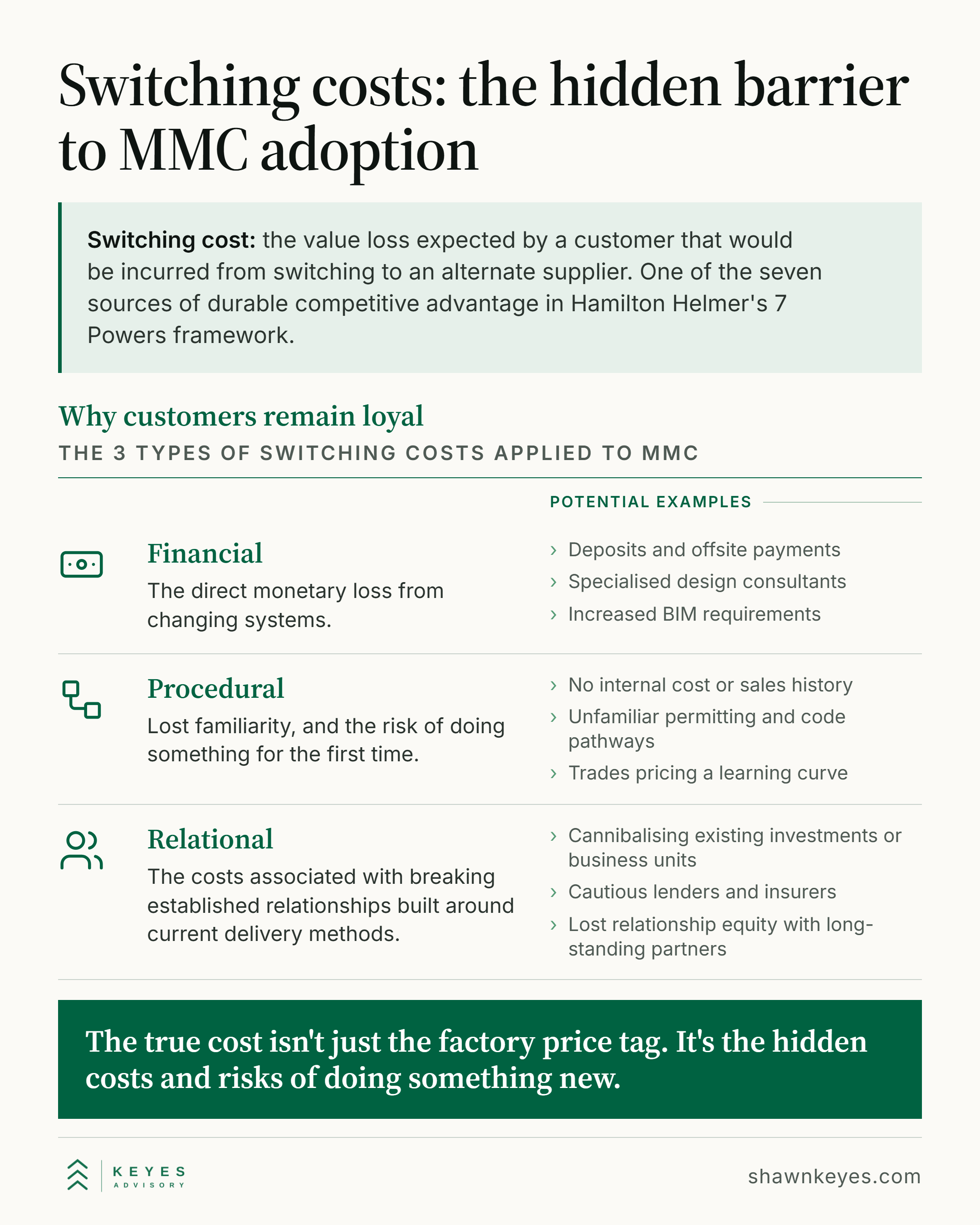
Helmer identifies three types of switching costs, all of which can be highly prevalent in construction: financial, procedural, and relational.
Financial
These are the direct, quantifiable monetary costs associated with adopting a new system. Beyond typical fabrication, supply and install fees, these could include:
- Additional design and pre-construction costs related to specialized consulting expertise, or an increased level of BIM development needed for a DfMA approach.
- Different payment structures, such as deposits required for offsite manufacturing.
Procedural
These cover the cost of lost organizational familiarity, as well as the risk and uncertainty of executing an unfamiliar methodology for the first time. In my experience this is where innovative projects can face their steepest challenges:
- Increased precon effort to align project teams around new workflows.
- Lack of internal historical data on cost and contingency.
- Fear of potential scope gaps created by new systems.
- Unfamiliar permitting, approvals and building code pathways.
- Higher bid pricing from trade partners who price in their own learning curves.
- Sale and lease-up uncertainty due to a lack of local precedent projects.
Relational
These are the costs of breaking established relationships built around traditional delivery methods. Builders and developers have pre-existing relationships with consultants, trades, suppliers, and municipal officials built over decades. Adopting MMC can disrupt these relationships:
- The overhead of identifying, vetting, and qualifying new fabricators, sub-trades and consultants.
- Lost volume discounts and relational equity with existing trade and consulting partners.
- Potential cannibalization of internal business units or competing investments in traditional trade setups.
- Reluctance from conservative lenders, insurers, and warranty providers unfamiliar with offsite construction.
Critically, some of these hurdles extend beyond the client's control. Even when a builder or developer is willing to bear their own internal switching costs, institutional friction across the financing and regulatory environment can still limit adoption.
The result is a powerful incentive to stick with traditional methods.
Five strategies to overcome switching costs
Helmer notes that switching costs are non-exclusive. Once a new entrant acquires a customer, overcomes the initial friction, and establishes confidence, those same switching costs can start working in the challenger's favour.
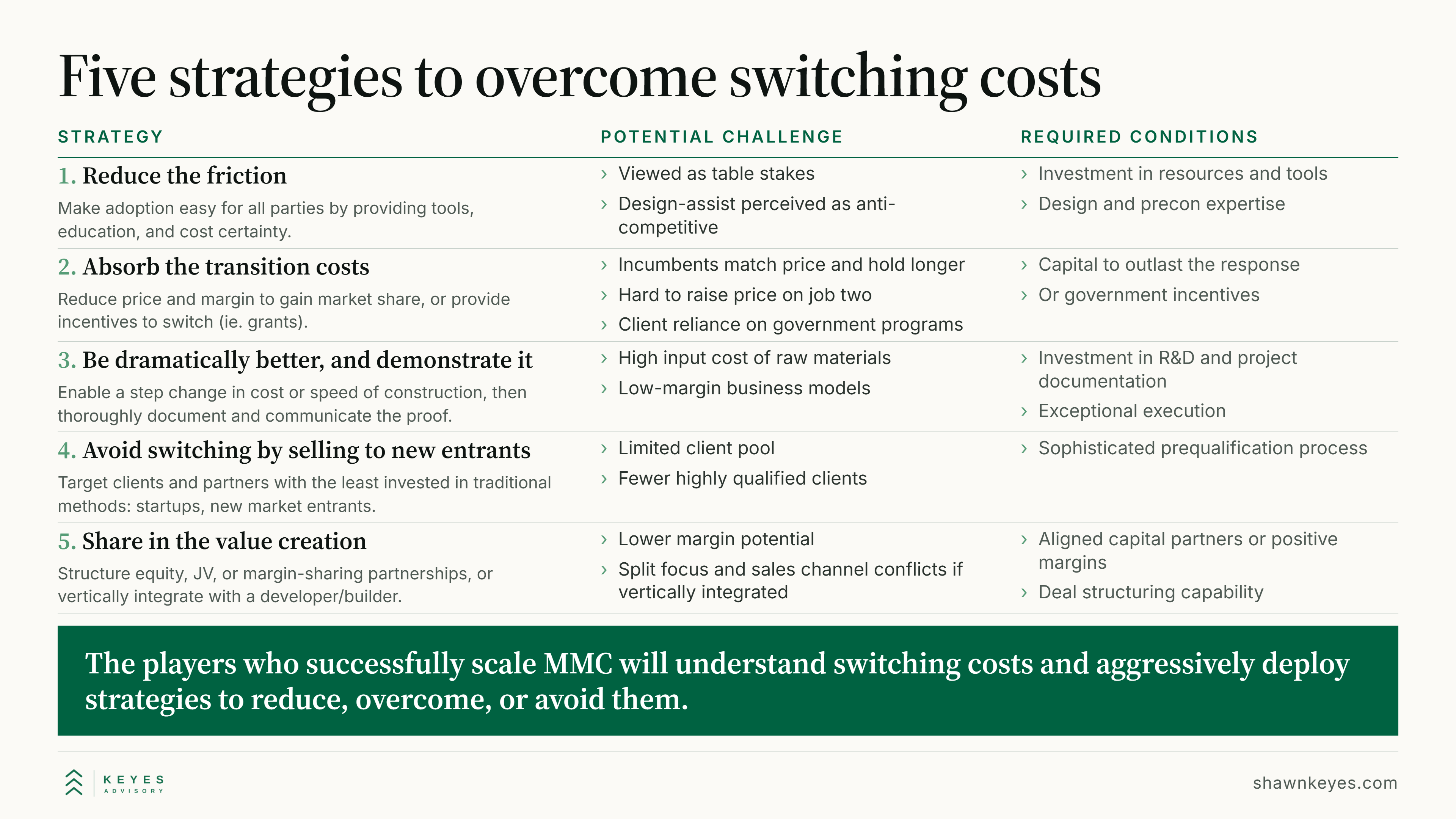
So how can MMC companies overcome switching costs? From first principles, I see five options worth exploring.
1. Reduce the friction
This is the most common strategy deployed by MMC companies. Fabricators and system manufacturers try to make their products easier for AEC+D to adopt by offering pre-engineered systems, design-assist services, open-source detail libraries, design and automation tools, and free training. Industry-wide policy and capacity building programs help reduce this friction too.
These approaches can be effective, but they require significant time and investment, and can be viewed as standard requirements rather than differentiators from the existing build system. Fabricator-led design-assist can also be perceived by some as a sales tactic to lock in a particular system early, which lowers perceived competition and creates added supply-chain risk.
2. Absorb the transition costs
Challengers can try to absorb switching costs by discounting prices to acquire customers. This is a dangerous strategy: incumbents will typically lower prices in response and can likely withstand margin pressure longer. It may be defensible when the challenger is well enough capitalized to absorb the initial cost of acquisition and build its own switching costs, so that customer lifetime value ultimately exceeds the cost of winning the business.
At the policy level this can be an effective strategy, and government programs can play an important role in absorbing the transition cost through grants and incentives. Initiatives like the Mass Timber Demonstration Program, GCWood, BC Housing's DASH, and Build Canada Homes can provide the initial incentive needed to de-risk early adoption of MMC and ultimately increase construction productivity.
3. Be dramatically better, and demonstrate it
The cleanest way for any company to overcome switching costs is to offer a product or service so compelling that the customer willingly accepts the cost of switching. For MMC, this would require a step-change improvement in time and/or cost of construction. Being slightly faster or slightly cheaper is not enough to compel a project team to overhaul its existing business.
In tech startup circles, VCs typically recommend aiming for a solution that is "10x better" to ensure the product will sell. That is an extraordinarily high, and likely unachievable, bar for most physical construction given fixed raw material costs.
Simply having a superior building system is not sufficient by itself. Companies must also ensure the perceived financial performance of the building system is superior, through demonstration, documentation and communication to a risk-averse, skeptical market of construction professionals.
4. Avoid switching costs by selling to new entrants
Perhaps one of the more underappreciated strategies is highly targeted customer selection. Not every client carries the same switching cost burden.
An established developer or builder with decades of concrete experience has significant organizational relationships, process, and expertise built around that system. They may also have complementary investments. By contrast, a developer or builder moving into a new market segment likely has far fewer ties, and a new entrant or startup has virtually none.
The best initial customer may not be the largest player in the market, but the client with the least to unlearn.
5. Share in the value creation
The final strategy for MMC platforms to overcome switching costs is to directly share in the financial upside created through industrialization efficiencies. In practice, this means moving beyond transactional sales toward equity partnerships, joint ventures, and risk-sharing delivery.
Vertical integration with development or general contracting businesses is another avenue to achieve the same effect, although it may reduce the attractiveness of the offer to other potential clients and create split focus between the different businesses.
The outlook for MMC
Having an efficient building system is a critical baseline, but the central strategic question isn't simply "is our product better?" It's: how much does it cost our customer to switch to us?
The players who successfully scale MMC will understand switching costs and aggressively deploy strategies to reduce, overcome, or avoid them. Then they will create their own.